Stats · Annual report
Padel in Lithuania, in numbers
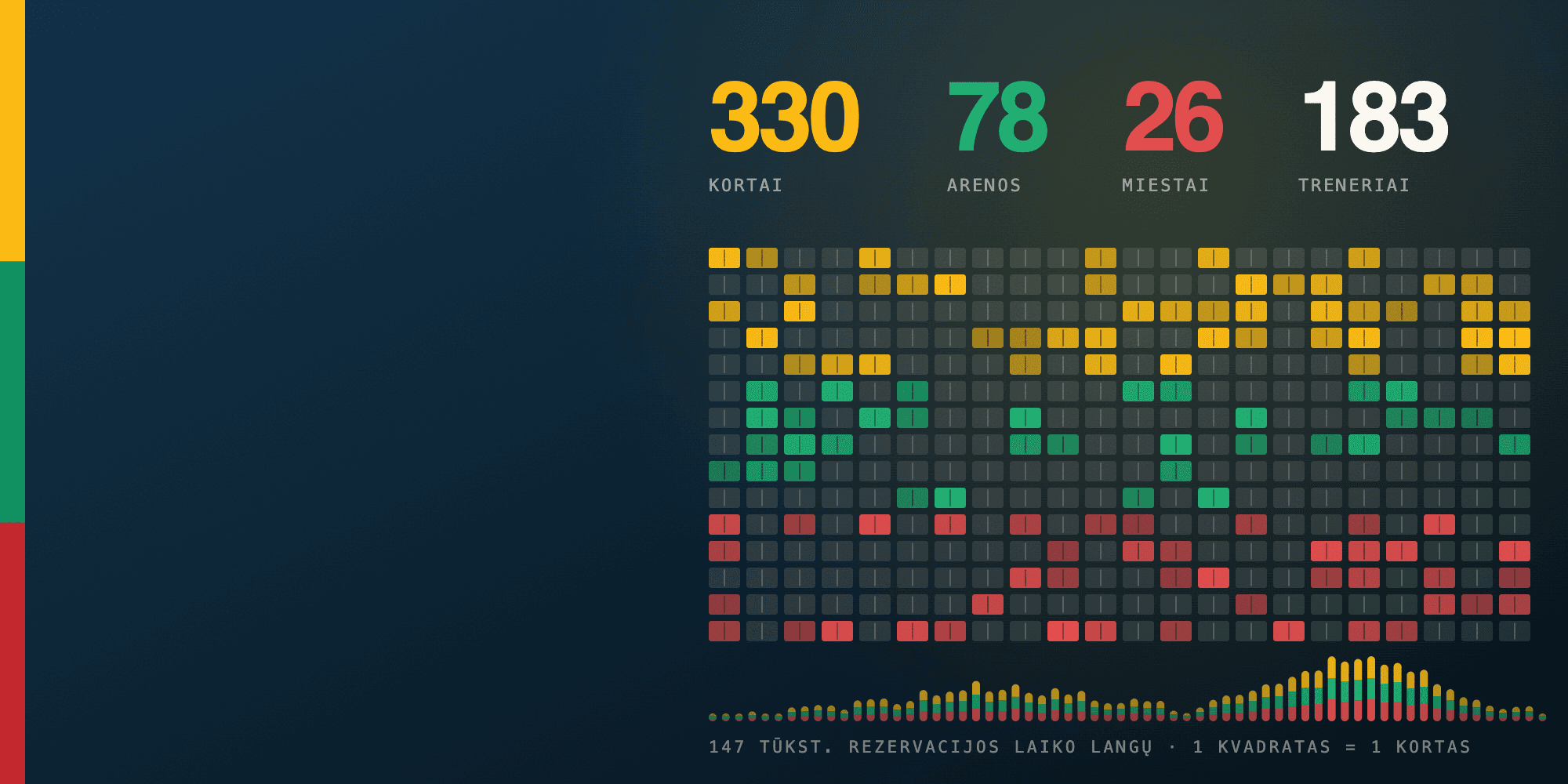
330 courts, 78 arenas, 26 cities and towns, 183 coaches. We counted the country's entire padel infrastructure and reviewed 147,000 booking slots to answer one simple question: how much padel does Lithuania actually have — and how much of it gets played?
Everyone talks about padel booming in Lithuania, yet the numbers are almost nowhere to be found. This report is an attempt to put them on the table: how many courts the country has and where they stand, how many are under a roof, when they're busy, how many coaches and tournaments there are. Every figure was aggregated from one source at one point in time, so they can all be read against each other.
The country at a glance
Three of those six numbers deserve their own sentence. 26 cities and towns means padel is no longer a big-city sport — there are courts in Ukmergė, Šilutė, Molėtai, Prienai and Ignalina. 75% under a roof is why padel in Lithuania is a year-round sport rather than a seasonal one. And 32,000 court-hours a week is the real capacity of the market: that's how much time the country's arenas publish for booking every week.
Courts and arenas: where they stand
The three biggest cities hold 65% of all courts, and Vilnius alone holds more than a third. But second place doesn't belong to Kaunas: Klaipėda, with 52 courts across nine arenas, edges out Kaunas by five courts — despite having barely half the population.
Cities with 9 or more courts. The remaining 33 courts are spread across 18 smaller locations.
The average Lithuanian padel arena has 5.2 courts, but that average hides very different objects: from a single outdoor court at a countryside guesthouse to an 18-court complex in Kaunas. The ten largest arenas together hold 120 courts — more than the whole of Vilnius.
| City | Arenas | Courts | Indoor | Outdoor | Courts / arena |
|---|---|---|---|---|---|
| Vilnius | 23 | 115 | 93 | 22 | 5.0 |
| Klaipėda | 9 | 52 | 37 | 15 | 5.8 |
| Kaunas | 7 | 47 | 34 | 13 | 6.7 |
| Šiauliai | 4 | 26 | 24 | 2 | 6.5 |
| Panevėžys | 4 | 22 | 19 | 3 | 5.5 |
| Klaipėda district | 3 | 17 | 13 | 4 | 5.7 |
| Palanga | 4 | 9 | 6 | 3 | 2.3 |
| Alytus | 4 | 9 | 5 | 4 | 2.3 |
| All Lithuania | 78 | 330 | 247 | 83 | 5.2 |
Three in four courts are indoors
Lithuania's padel infrastructure was built for the weather, not the sun. 247 of 330 courts are indoor, and that's the single most important fact about the sport here: it doesn't stop in November. In Šiauliai, 24 of 26 courts are under a roof; in Vilnius, 93 of 115. Outdoor courts cluster on the coast and in resort towns, where they work as a summer capacity add-on.
The gap shows up in demand too. In July, indoor occupancy runs at 23.2%, outdoor at 9.4%. Even in summer, when an outdoor court is the nicest option, players pick the roof: a guaranteed slot, floodlights and independence from the rain.
Courts per resident: Palanga leads
Absolute numbers favour Vilnius, but access to padel is better measured in courts per 100,000 residents. On that table the resorts and the port city come first, and Kaunas ends up last among the big cities.
In Palanga one court serves roughly 2,300 residents; in Kaunas, 6,600. The national average is 11.4 courts per 100,000 residents.
Palanga has nearly three times as many courts per 100,000 residents as Kaunas. Resort arenas are built not for the local population but for seasonal traffic — which is why they're the cheapest in the country in summer, and half of them stand idle in winter.
When Lithuania plays padel
We reviewed 147,446 half-hour slots published across 59 arenas over two weeks, and looked at which ones were taken. Overall occupancy is 19.6%, but the average is meaningless here: the daily curve has two clear humps and one deep valley.
Indoor courts peak at 19:00 (44.7%). A second, smaller peak comes at 11:00 (29.8%), when flexible-schedule players are on court. The outdoor curve is three times flatter.
The peak hour in Lithuania is 19:00, and it's nearly four times as dense as 8am. But the interesting part isn't the peak — it's midday: at 11:00, indoor occupancy hits 29.8%, more than at 15:00 or 16:00. That means a daytime-playing crowd has already formed here, even though those are the cheapest hours.
The weekly rhythm is simpler: Saturday beats every weekday by almost double, and Monday is the emptiest day of the week.
The evening peak (18:00–21:30) looks very different from city to city. In Vilnius almost half the evening slots are already taken — the threshold at which players start to feel there's "nothing available". In other cities more than three quarters of courts are still free in the evening.
| City | Courts observed | Evening occupancy |
|---|---|---|
| Vilnius | 88 | 45.7% |
| Klaipėda district | 17 | 35.7% |
| Kaunas | 47 | 28.6% |
| Klaipėda | 50 | 23.1% |
| Palanga | 9 | 14.9% |
| Alytus | 7 | 12.1% |
| Panevėžys | 22 | 12.1% |
Šiauliai is left out of this table: the city's largest arena doesn't publish its booking schedule publicly, so the 12 courts we can see don't reflect real demand.
See free courts across all of these arenas
Rallio merges the country's arena schedules into one view — free slots and prices side by side, instead of across a dozen different booking systems.
Coaches: 183 names, unevenly spread
The national coach directory holds 183 padel coaches working across 8 cities; 40 arenas have at least one assigned coach. But coach density doesn't track court density. In Kaunas there are 1.2 courts per coach, in Vilnius 1.6, and in Panevėžys 7.3. Where there are many courts and few coaches, it's hardest for beginners to get into the sport.
Kaunas has the most coaches per court, Panevėžys the fewest. 14 coaches did not state a city.
| City | Coaches | Courts | Courts per coach |
|---|---|---|---|
| Vilnius | 71 | 115 | 1.6 |
| Kaunas | 40 | 47 | 1.2 |
| Klaipėda | 31 | 52 | 1.7 |
| Šiauliai | 9 | 26 | 2.9 |
| Palanga | 6 | 9 | 1.5 |
| Alytus | 5 | 9 | 1.8 |
| Plungė | 4 | 4 | 1.0 |
| Panevėžys | 3 | 22 | 7.3 |
Tournaments: 49 dates, five organisers
Lithuania's padel competition calendar is run by five separate organisers and platforms. Between them they currently list 49 tournaments, 30 of which are still upcoming. The season has two clear peaks — July and September — and competitive life almost stops in December, even though the courts stay open.
Shows the rest of the season from June onward. Earlier 2026 months are excluded — calendars are collected from June, so past tournaments are counted incompletely.
What's next: six arenas under construction
The registry holds another six arenas that aren't open yet: one built and awaiting opening, three planned, two in design. If all of them open, the country's arena count grows by about 8% — which means the bigger change in the coming years won't be the number of courts but their occupancy: today the average Lithuanian court stands empty four hours out of five.
| Stage | Arenas |
|---|---|
| Planned | 3 |
| Technical design | 1 |
| Concept design | 1 |
| Built, not yet open | 1 |
Five takeaways
- Padel in Lithuania is an indoor sport. 75% of courts are under a roof, and they collect 87% of all bookings.
- The market is no longer big-city only. Courts stand in 26 locations, among them Ukmergė, Šilutė, Molėtai and Ignalina.
- What's short isn't courts, it's evening hours. The national average is 19.6% occupancy, but the Vilnius evening runs at 45.7%.
- Midday is no longer empty. Occupancy at 11:00 is higher than at 15:00, even though prices are lowest then.
- Coaches are spread more unevenly than courts. From 1.2 courts per coach in Kaunas to 7.3 in Panevėžys.
We covered what all of this costs separately: how much a padel court costs in Lithuania — an analysis of 123,919 priced booking slots.
Methodology
This report draws on two datasets, both aggregated on 20 July 2026.
Infrastructure registry. Rallio's arena and court registry: 78 operating Lithuanian padel sites and 330 courts with a stated type (indoor / outdoor). The registry covers commercial arenas as well as public and guesthouse courts. Not-yet-open sites (counted separately) and non-Lithuanian arenas are excluded.
Booking panel. Public arena booking schedules, crawled for the 2026-07-10–07-25 window: 147,446 half-hour slots across 59 arenas and 285 courts. "Occupancy" here means the share of published slots already taken at crawl time — a demand signal, not revenue, and a lower bound: dates further out have naturally had less time to fill. Arenas that don't publish a schedule or take bookings by phone don't appear in the demand cuts — those cases are flagged next to the relevant tables.
Coaches and tournaments. Coach count is entries in Rallio's coach directory (183); tournaments are an aggregation of five Lithuanian competition calendars (49 tournaments, 30 of them upcoming). Tournament calendars are collected from June 2026, so earlier months this year are incomplete and are not shown in the by-month cut.
Population figures. VĮ Registrų centras municipality resident data as of 3 January 2026. Figures are calculated per municipality, not per city.
The figures in this report may be freely cited with attribution to "Rallio, Padel in Lithuania in numbers (2026)" and a link to this page. Questions and more granular cuts — get in touch.