Guide · Playing guide
Padel etiquette: the unwritten court rules
Four players, one glass box, ninety paid minutes and nobody in a chair to referee any of it. None of these rules are in the rulebook. All of them decide whether the group invites you back.
Padel at club level has no umpire. No line judge, no video review, no one to appeal to. Every call, every warm-up, every ball fed back to a server is negotiated on the fly by four people sharing a twenty by ten metre room for an hour or ninety minutes. That is the whole reason padel etiquette exists — and the reason breaking it is noticed so quickly.
Why padel punishes bad etiquette faster than tennis
A tennis court is thirty-six metres of open space and you spend most of it a long way from everyone else. A padel court is twenty metres by ten, enclosed in glass and mesh, and it is played almost entirely as doubles. Four people, one enclosed room, every gesture visible and every delay audible. The sport is also booked in strict blocks, so friction is not abstract — a slow warm-up or a five-minute argument about a line comes directly out of somebody's paid time.
Then there is the officiating. Professional padel does have chair umpires, and the top tours have added review technology. Your Tuesday evening game has none of that. It runs on an honour system: you call your own lines, you replay what you genuinely disagree about, and you regulate your own pace. An honour system only works while everybody keeps their end of it, which is why the community reacts to breaches far out of proportion to how small they look written down.
Six places where etiquette actually gets decided
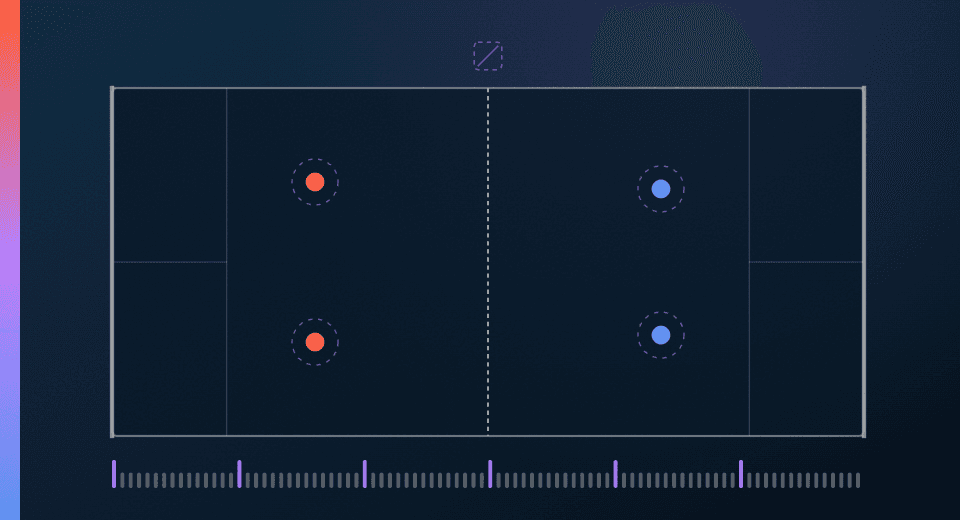
Almost every unwritten rule attaches to a specific piece of the court. It is easier to remember them as places than as a list.
Drawn to the official specification: 20 m by 10 m, with the service lines 6.95 m from the net. Positions show a typical point after the serve — one pair at the net, one defending deep.
- 01The door. Never open it while a point is live — not on your court, and not on the one you are walking past.
- 02The net post. If you are not serving, spare balls live here, not in your pocket and not in your hand.
- 03The server's spot. Say the score out loud before you bounce the ball, every single time.
- 04The middle. The ball down the middle belongs to whoever calls it first. Silent pairs collide.
- 05The back glass. Playing the wall is padel, not a lucky escape. Nobody owes an apology for using it.
- 06The opponent at the net, two metres away and facing you. The one place a full smash never goes.
Before you step on court
Arrive early, be ready when the clock starts
Ten to fifteen minutes before your slot is the usual target. Most clubs let you onto the court a few minutes before the hour, and being on it and moving when the block starts respects the group ahead of you as much as your own partners. Arriving late does not earn you extra time at the end — the next group's booking has already started.
Wait off the court, though. Standing at the door with your pala in hand while the previous four are still playing makes them feel hunted, and it does not get you on any earlier. Watch from the bench and walk in when the clock turns.
Wear the right shoes, and clothes with pockets
Non-marking soles are required at most clubs, and a padel-specific herringbone or omni sole grips artificial turf far better than a flat gym shoe. The pockets matter more than they sound. Pockets carry the second serve ball. The player who turns up without them is the player whose partner spends the whole service game fetching.
The warm-up everybody gets wrong in one of two directions
The first three to five minutes are for finding the ball, the pace and the walls. They are cooperative. Rally at half speed, hit to your partner and your opponents at a height they can actually take, and work in a few volleys and overheads so that everyone has hit the shots they are about to play under pressure.
There are exactly two ways to get this wrong, and they are opposites:
- Full power from ball one. Winding up a smash at somebody who is still rolling their shoulder out.
- The six-ball warm-up. Hitting a handful and announcing you are ready, which denies the other pair the ground strokes they need to get loose.
Both read to the other three players as the same sentence: I have already decided I am better than you. The fix is one question — ask whether everyone is ready before the first serve.
Ten rules during play
These are the ones that experienced players assume you already know, which is precisely why nobody ever tells you them.
1. Never cross a live court
Wait for the point to end before walking behind, across or into any court — including your own, if you stepped out for water. This is the most universally enforced convention in the sport, and the one most likely to get you an audible reaction from strangers.
2. Return a neighbour's ball gently, and after their point
If a ball rolls in from the next court, pick it up and hold it. Wait for their rally to finish, then send it back with a soft underarm bounce or a roll along the floor towards their server. Not a lob over the glass into the middle of their game.
3. Call the score before every serve
Out loud, in the language everyone on court is using, before the ball bounces. Ambiguous scores start more arguments than close line calls do, and they start them three points later when nobody can reconstruct what happened.
4. Manage the balls
- If you are not serving, do not fill your pockets. Leave spares at the net post or feed them over.
- Never play a point with a spare ball in your non-racket hand. It is distracting and it is unsafe.
- After a fault or a finished rally, feed the next ball to the server properly — see the next diagram, because this is the one people think they are already doing correctly.
Only one of them is a courtesy. The other two both look like helpfulness and both cost the server time, balance or a flinch.
5. Call your own lines, replay genuine doubt
You are the only line judge on your side of the net, and only on your side. Call your own balls out honestly, give the benefit of the doubt when it is genuinely close, and offer a let when there is real disagreement. Refusing a let after a dispute is worse form than the disputed call was. A serve that clips the line is in.
6. Say mine or yours
On anything down the middle, or any ball at an ambiguous height, call it loudly and call it early — early enough that your partner can still stop. Pairs that do not talk swing into each other's rackets, which is how a friendly game produces the only injury of the evening.
7. Acknowledge net cords and freak bounces
Raise a hand or tap your pala after a net cord, a mis-hit that dies in the corner, or a ball that takes an impossible deflection off a fence post. It costs you nothing and it keeps the temperature down for the next forty minutes.
8. The overhead goes to the glass, not to a body
Large enough to need its own section — see below.
9. Drop the fridge in social games
Parking every single ball on the weakest player until they stop moving is a legitimate tournament tactic, arguable in a ladder, and rude in a social mixer where all four people paid the same amount for the same court. Vary the target. Let the weaker player have rallies — you will get a better hour out of it too.
10. Celebrate your points, not their mistakes
Fist-pump a winner you hit. Do not fist-pump a double fault they served. The distinction is small, it is completely obvious to everyone watching, and it is the single fastest way to change how a game feels.
The smash question, answered properly
This is the rule most often stated badly, including in most guides you will find on the subject. The usual version is a list of shots you are supposed to play instead of a smash, with the bandeja somewhere in it. That is a technical mistake, and padel players notice it immediately.
| Where the lob has put you | The shot | What it is actually for |
|---|---|---|
| Pushed back, off balance | Bandeja | Neutralise. Slow, sliced, deep — it buys back the net rather than ending anything. |
| Deep but balanced | Vibora | Pressure. Side-spin and pace to force a weak return, not usually a clean winner. |
| Short lob, you are set under it | Smash into the glass | Finish. The bounce off the back wall is what makes it unreturnable, not the impact point. |
| Short lob, high bounce available | Por tres | Finish. Send it out of the court entirely and make them chase it outside. |
| Any lob, opponent two metres away at the net | Anything except their body | They have no time to turn. This is the whole rule. |
Note what this framing does: it never asks you to play worse padel. Every finishing option is still on the table. The only thing removed is the one that ends with somebody holding their face — and which, in a social game, is also the least reliable way to win the point, because a flat ball at a body is the easiest thing on court to block back.
What poor etiquette actually costs, in minutes
The abstract argument for etiquette is that it is polite. The concrete one is that it is the difference between playing for eighty minutes and playing for sixty-seven.
Both bars are one 90-minute booking. The only difference between them is whether four people kept the conventions.
5 min warm-up · 81 min playing · 4 min close the point, collect balls, out
7 min previous pair still on, your fourth still parking · 5 min warm-up · 67 min playing · 4 min chasing balls, re-agreeing the score · 7 min you overrun, the next pair waits
Fourteen minutes, which is roughly three games. Nobody in the second bar did anything outrageous — they were late, they hunted balls, they re-agreed the score, and they ran over the end into the next group's booking.
Etiquette with your own partner
Doubles chemistry is fragile in a room this small, and your partner hears everything. The four sins that come up most:
- Blaming them out loud after a miss. Say next one, or say nothing. Both work. A sigh does not count as nothing.
- Coaching that was not asked for. A short tactical call between points is normal. A technique lecture at 3-2 is not, and it will not be absorbed anyway.
- Throwing the pala into the fence or the glass. It carries to every court in the building, and at some clubs it ends your session.
- Phone, watch or vape between points. Save it for the changeover.
And the positive one: tap palas with your partner after every point, won or lost. It is the padel handshake, it takes half a second, and pairs that do it stay in sync through a bad set far better than pairs that do not.
Changeovers, the walls, and the end of the block
Change ends after every odd game — 1, 3, 5 — as in tennis. On an enclosed court you do it through the doors in the side walls, so nobody is climbing over anything. Keep changeovers short in social play: drink, breathe, get back.
Playing the walls is not something to apologise for. The back glass and the side glass are the sport, and deliberately using the fence to change the ball's direction is an advanced tactic, not gamesmanship. The only wall shot that gets an acknowledgement is the freak one — a ball that hits a corner post and dies at somebody's feet gets the same raised hand as a net cord.
When the booking ends, the court is over, mid-game if necessary. If the next group is at the gate, close the point you are in and step off. Then: meet at the net and tap palas or shake hands with all three others, pick up your balls, bottles, grip wrappers and tape, take bags off the benches inside the cage, and settle the court fee before anyone has to ask twice.
Mixed levels and mixed games
Social padel constantly puts different levels on the same court, and the conventions tighten rather than relax when it does. Play with control rather than maximum power, and match your pace to the level of the point rather than the level of your best shot. Do not aim everything at one player because they are the weakest. Keep coaching to yourself unless you are asked — encouragement yes, corrections no. And if the slot was advertised as social or mixed, honour what it said: that is not the hour to road-test your competitive game.
The checklist
Screenshot this one and send it to whoever you are playing with on Thursday.
Ten rules that cover ninety percent of it
- 01Arrive 10-15 minutes early. Be on court, not in the corridor, when the clock starts.
- 02Non-marking court shoes, and clothing with pockets.
- 03Say the score out loud before every serve.
- 04Feed the next ball softly, on the bounce, to the server's forehand.
- 05Call your own lines honestly. Offer a let on a genuine doubt.
- 06Shout mine or yours on anything down the middle.
- 07Never cross a live court. Return a neighbour's ball after their point, not during it.
- 08No smash at a body, and no parking every ball on the weakest player in a social game.
- 09Raise a hand for a net cord or a freak deflection off the frame.
- 10Off the court on time, mid-game if that is what it takes.
Why any of this matters: the invite is the scoreboard
Here is the uncomfortable part. Every one of these rules is enforced by a mechanism nobody talks about and nobody can see: whether somebody thinks of you when they need a fourth. There is no card, no warning, no conversation. The group chat simply gets quieter.
That mechanism is brutally unfair in one specific direction. It rewards the players who already know everyone. A newcomer with immaculate manners and a decent forehand is invisible to it, because the people organising games are working from memory and a contact list. The etiquette does not fail — the distribution does.
Which is the actual reason we built the games surface the way we did. On Rallio an open game states its level, venue, time and price up front and stays visible until it starts, so getting in is a matter of matching the level rather than knowing the organiser. Your games and your rating travel with you between clubs, which means the good habits in this article accumulate into something a stranger can see before they have ever played with you.
Etiquette still does the work. It just stops being a secret handshake.
Play with people who play the same way you do
Open games across every club, with the level, the venue and the price stated before you join — no scrolling back through a chat to find out what you signed up for.
Frequently asked questions
What is padel etiquette?
Padel etiquette is the set of unwritten conventions that govern a self-officiated doubles match: how you warm up, how you call your own lines, how you return a neighbouring court's ball, where you aim an overhead in a social game, and when you get off court. None of it appears in the FIP rulebook, which covers the laws of the game rather than the manners around it.
Can you smash at an opponent in padel?
It is legal, and at professional level it happens. In a social or mixed-level game it is the fastest way to stop being invited. The opponent is often two metres away with no time to turn, so the convention is to aim a finishing smash at the glass or through the gap, and to use a bandeja or vibora when you are not in position to finish cleanly.
Who calls the lines in padel?
Each pair calls the lines on their own side of the net, and only on their own side. The convention is to give the benefit of the doubt on a genuinely close ball and to offer a let when there is real disagreement. A serve that clips the line is in.
How long should a padel warm-up be?
Three to five minutes of the booked slot is the normal expectation. It is cooperative, not competitive: half-pace rallies at a comfortable height, plus a few volleys and overheads so everyone has hit the shots they are about to play. Hitting full power from the first ball, or demanding to start after six, both read the same way to the other three players.
When do you change ends in padel?
After every odd-numbered game: 1, 3, 5 and so on, the same as tennis. On an enclosed court you change through the doors in the side walls, so the ends swap without anyone climbing anything.
A note on sources
Two different kinds of claim appear above and they are not evidenced the same way. Anything about the laws of padel — the 20 by 10 metre court, the service line 6.95 m from the net, changing ends after odd games, a serve that clips the line being in — comes from the FIP Rules of Padel and is checkable. Everything else is a convention, which means it is real, widely shared, and has no authority behind it beyond the fact that experienced players expect it.
We have deliberately not dressed the second kind up as the first. Conventions like these circulate through club noticeboards, coaches, and the arguments players have about them online, and citing a handful of blog posts would imply a precision that does not exist. Where a norm is genuinely contested — how hard you may smash in a mixed game, whether fridging is ever acceptable outside a tournament — we have said so rather than picking a side and sourcing it.
One convention in the list is local rather than universal: in some communities the losing pair buys the coffee afterwards. Check what your own club does before assuming.
Other guides from us: how Lithuania's padel chat groups actually work and padel in Lithuania in numbers.
Spotted something we have got wrong, or a convention that works differently at your club? Tell us — this guide is meant to be corrected.